Agent Experience
Monitoring & Insights


What’s the right balance between creating original content vs. earning third-party citations?
- Should I focus on my own content or getting mentioned on other sites for AI search?
- When is it better to earn a placement in a cited source than create a new page?
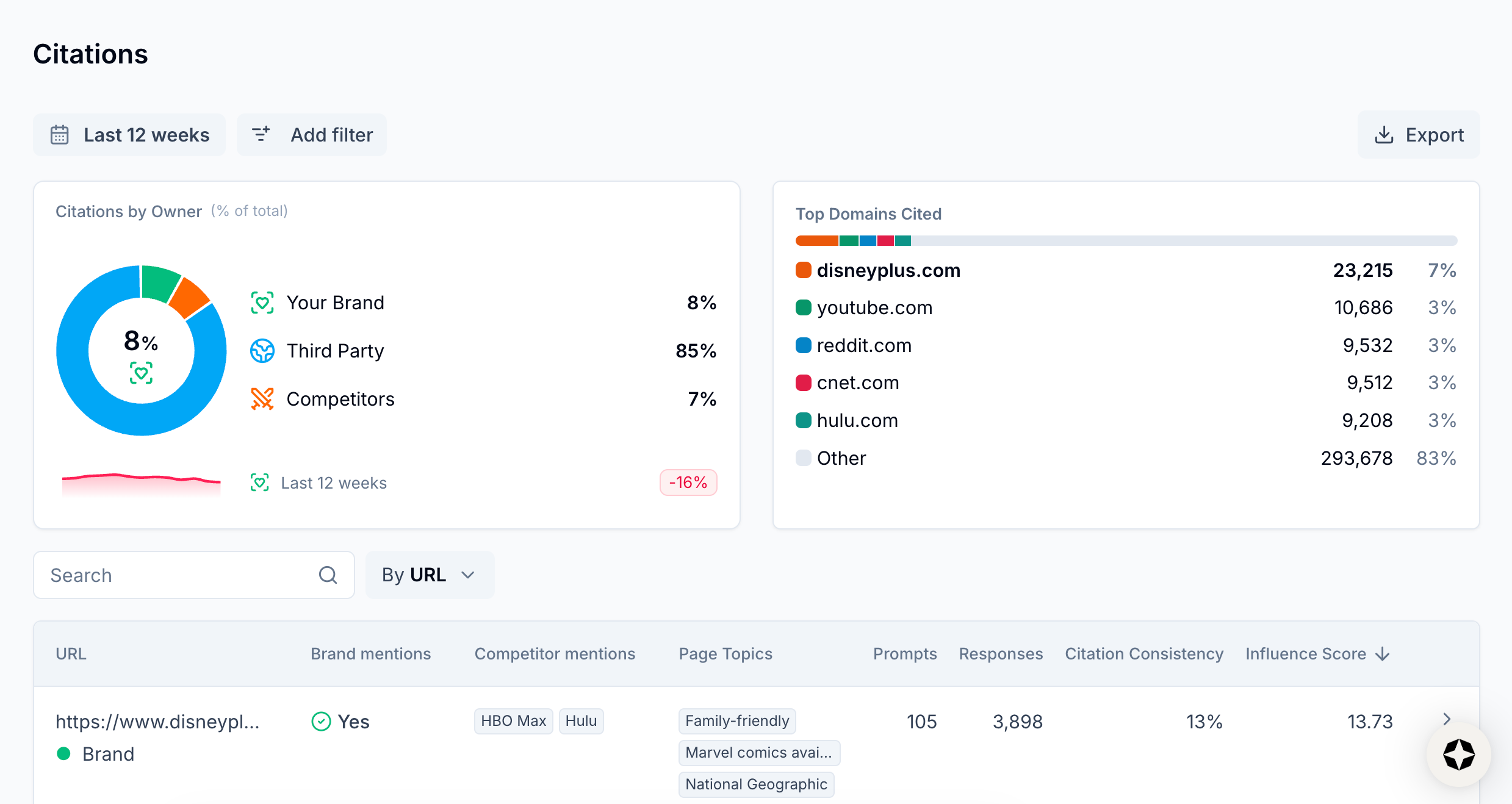
Scrunch recommends pursuing both brand citations and placements in cited sources. It’s worth investing in original content when competitors are the cited source, as they likely won’t offer placement opportunities, and when cited sources are substance-light or mismatched to the prompt. Meanwhile, getting mentioned in trusted, frequently-cited sources will improve AI search performance and establish credibility.
Example
For example, imagine a Scrunch user at a cybersecurity company is tracking the prompt, "What's the best endpoint security software for small businesses?"
In the Citations tab, they find three types of sources appearing frequently in AI responses:
Scenario 1: Competitor pages (invest in original content)
A competitor's product page appears in 65% of responses. Since the competitor is unlikely to offer a placement opportunity, the user instead focuses on creating a stronger original page—a detailed comparison guide with structured data, clear use cases, and other optimizations—designed to displace it.
Scenario 2: Substance-light cited sources (invest in original content)
A blog post titled "Best Endpoint Security Tools" appears in 40% of responses but contains only a brief paragraph per tool with no real depth. The user creates a more authoritative alternative—with benchmarks, expert quotes, and a detailed feature breakdown—to give AI platforms a better source to cite.
Scenario 3: Trusted third-party domains (pursue placement)
A well-known cybersecurity review site appears consistently across dozens of the user's tracked prompts. Rather than competing with it, the user contacts the site to request a product listing or contributed article, earning a mention in a source AI platforms already trust and cite frequently.
Follow-up question: What patterns typically indicate a “low-hanging fruit” citation opportunity?
Patterns that typically indicate a low-hanging fruit citation opportunity include:
Brand citations:
- Thin, surface-level content with little real detail
- Page titles or descriptions that suggest content answers a prompt, but the content doesn’t actually deliver
- Clear errors or gaps that make the page less helpful or trustworthy
Third-party placements:
- Domains that appear consistently across many prompts
- Third-party pages that cite competitors but not the user’s brand
- Influential pages for a key topic that don’t mention the user’s brand