Agent Experience
Monitoring & Insights


How many prompts should I track for AI search?
- What's the ideal number of prompts to track?
- How many AI search prompts should I start with?
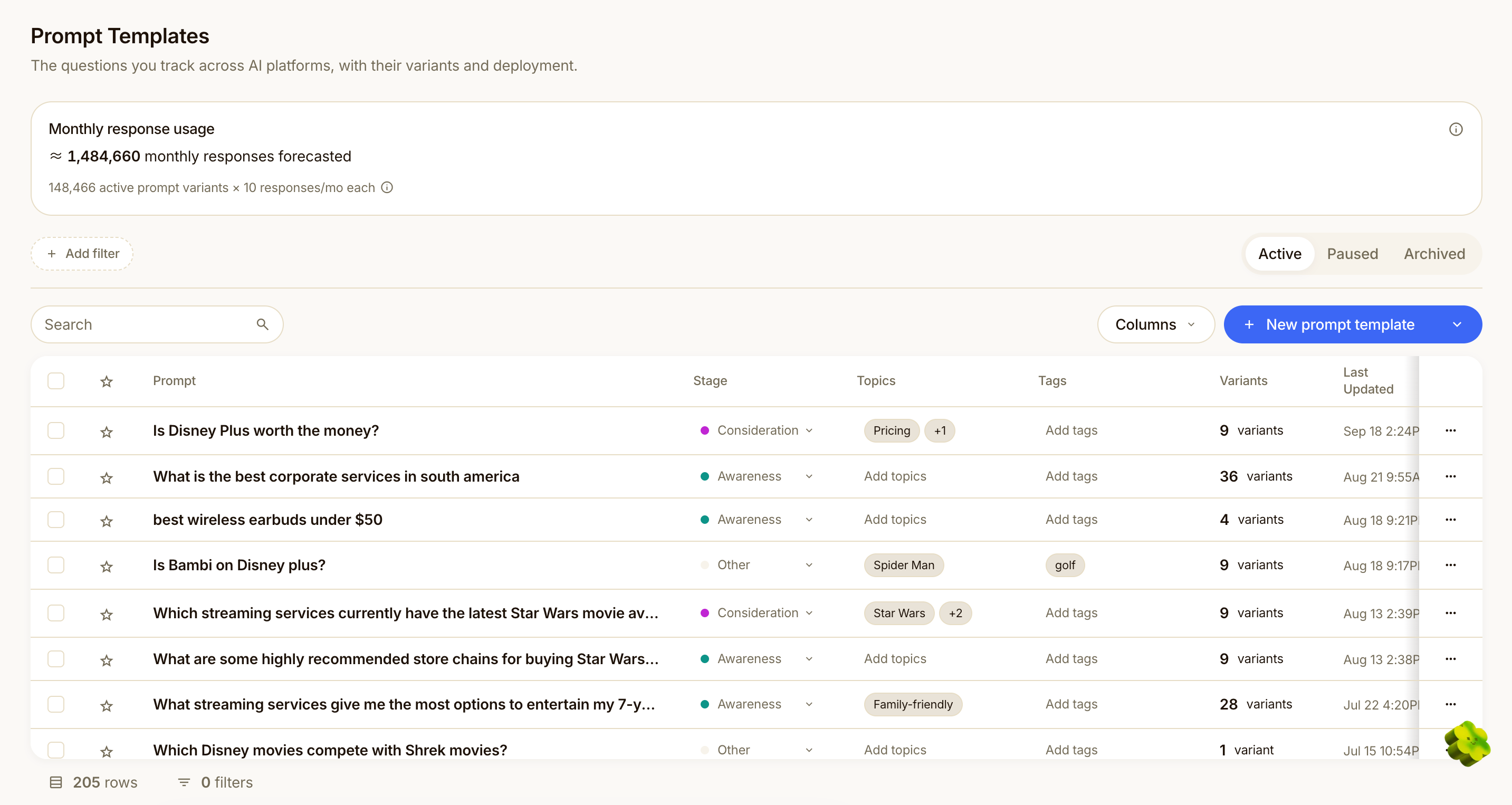
Scrunch recommends estimating how many prompts to track for AI search using the following approach: X [# of topic clusters] x Y [12-15 questions related to each topic cluster] = Z [# of AI search prompts to track]. The primary goal is to get a representative sampling of data across all customer journey stages via a mix of branded and non-branded prompts.
Additional context: Scrunch also recommends using its Topic Prompt Optimizations tool to identify which prompts contribute unique value and which prompts are unnecessary.
Example
For example, a Scrunch user at an enterprise SaaS company determining their prompt tracking needs would follow this workflow:
Step 1: Identify topic clusters
Start with SEO keywords, paid search keywords, and major product and content areas of the website. Then sort and group the list into topic clusters based on common themes (e.g, product use cases, competitors and alternatives, etc.). Each topic cluster should have somewhere between 5-15 keywords associated with it.
In this case, the user identified 300 topic clusters from 3,000 keywords.
Step 2: Formulate questions for topic clusters
Aim for 12-15 questions for each topic cluster that map to the different stages of the funnel (i.e., awareness, consideration, conversion, and loyalty), include branded and non-branded variations, and are informed by questions that commonly appear in SEO research, PPC queries, and communications to sales, success, and support teams.
In this case, the user created an average of 15 questions per topic cluster.
Step 3: Estimate total number of prompts
Multiply the number of topic clusters by the number of questions. The result is an approximation of how many prompts to track.
In this case, the user multiplied 300 topic clusters by 15 questions, resulting in 4,500 prompts.
If you're tracking a large number of prompts: Organize prompts by topic, persona, funnel stage, custom tag, and other filters to obtain clearer reporting and analysis.
Step 4: Prune prompts to find the right number and mix for a topic
Allow prompts to run for a minimum of 2 weeks to collect necessary data, then use Topic Prompt Optimizations to identify which prompts deliver unique value and which can be cut.
Archive prompts that don’t add meaningful new coverage for a topic to cut costs or to make room to add new prompts for topics that may not have sufficient coverage.
Follow-up question: How do I know if my prompt strategy reflects real user behavior?
Scrunch recommends tracking AI agent traffic and AI referral patterns. Compare the most frequently crawled and visited URLs with existing prompts to ensure prompt coverage and identify gaps where high-traffic pages lack corresponding prompts.
Brands should also refresh their prompt lists over time by:
- Reviewing AI search trend data on a monthly basis to identify new topics and related prompts
- Adding new prompts on a quarterly basis to reflect product launches, campaigns, and competitive landscape changes
- Using Topic Prompt Optimizations on an ongoing basis to find and archive redundant prompts