Agent Experience
Monitoring & Insights


How does Scrunch’s AI site audit differ from a traditional SEO crawl?
- How is AEO auditing different from SEO auditing?
- What does Scrunch's site audit check for?
Scrunch’s AI site audit is focused on answer engine optimization (AEO)/generative engine optimization (GEO), not traditional search engine optimization (SEO). It ensures content is accessible and readable for AI platforms like ChatGPT, Perplexity, Gemini, and others to increase brand presence and citations in AI responses, not to rank higher in search engine results pages (SERPs).
Additional context:The goal of SEO is to optimize for rankings and clicks in traditional search engines like Google and Bing. The goal of AEO/GEO is to optimize for visibility, favorability, and accuracy in AI platforms.
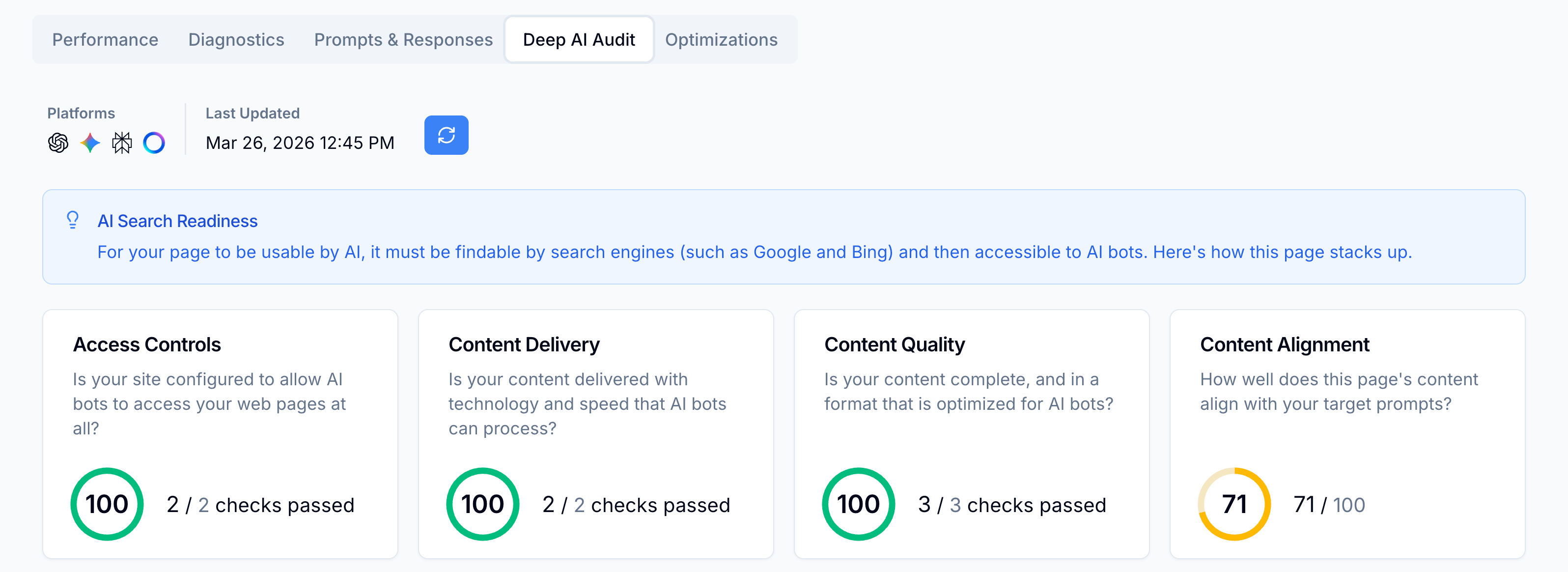
Example
For example, traditional SEO crawls identify issues that may impact ranking in SERPs, like broken links, missing meta tags, and website speed for human browsers.
Scrunch’s AI site audit diagnoses technical and content issues that may prevent AI bots from accessing or consuming site content, like blocked AI user agents, JavaScript rendering problems, and content quality or alignment.
Because Scrunch’s AI site audit is focused on what AI bots can access and read, it flags issues traditional SEO crawls would miss.
This may include pages where key text is not present in the raw HTML and overly complex markup or fragmented structures that make content difficult for AI to parse.
Follow-up question: Should I run Scrunch's AI site audit on every page or focus on specific pages first?
Scrunch recommends using its Site Maps feature to prioritize page auditing and optimization. Audit Scores will tell you the technical health of a page based on content quality, structure, and links. Meanwhile, pages that see a high number of AI requests to access the page but have a low number of citations are prime candidates for further investigation.